

Montana Western Launches Land, Water and Sky Center to Advance Experiential Learning and Natural Resource Stewardship
June 12, 2026
The University of Montana Western is proud to announce the creation of the Land, Water and Sky (LWS) Center, a new interdisciplinary hub for experiential education, undergraduate research, and community-based natural resource stewardship.
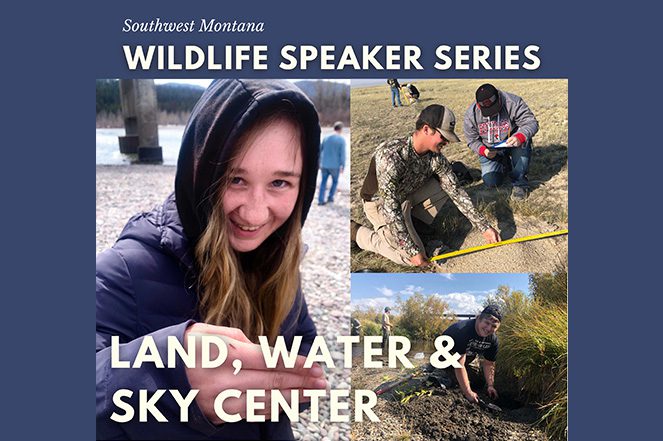
The LWS Center builds upon Montana Western’s nationally recognized Experience One (X1) model, where students and professors are immersed in one course at a time for concentrated, experiential learning. Classes and student projects are tied to collaborative projects with agencies, organizations, and landowners to enhance working and wild lands and headwater river systems across southwest Montana. In doing so, the Center builds capacity for long-term research and stewardship.
The Land, Water and Sky Center represents an evolution of experiential education at Montana Western. “Our students want meaningful opportunities to learn, contribute, and build careers in the landscapes they love,” said UMW Associate Professor Dr. Arica Crootof. “What better way to do this than engage students in existing on-the-ground projects while also filling needed monitoring, evaluation, and research gaps?”
The LWS Center supports interdisciplinary projects across ecology, education, environmental sciences, humanities, and mathematics. Students are working on applied research and service-learning projects, including stream restoration, wildlife and vegetation monitoring, watershed education, animal behavior modeling, habitat enhancement, regenerative agriculture, environmental literacy, and geospatial data analysis. Students work on these projects in different classes as well as across their four years of college, so they are involved in all stages of research—from grant writing and data collection to data analysis and report writing, to sharing results with academics, partners, and public audiences.
“Our goal is to create a collaborative hub where academic knowledge and community knowledge work together,” said Dr. Anderson. “We see an opportunity to coordinate efforts and leverage strengths across our community to build capacity for landscape-scale stewardship. At the same time, we are preparing students to become the next generation of scientists, managers, educators, and leaders.”
The LWS Center is designed to meet local needs, including workforce shortages and increasing complexity in resource management. Through long-term partnerships, applied research, and workforce development, the Center aims to help Southwest Montana plan, prepare, and respond to changing environmental conditions such as drought, wildfire, and invasive species.
Current projects include:
- Assessing ecological and hydrological impacts of stream restoration projects in collaboration with The Sagebrush Partnership, Big Hole Watershed Committee, and Montana Conservation Corps.
- Investigating how “Dark Skies” impacts wildlife and tourism in Southwest Montana.
- Co-developing criteria for whitebark pine friendly ranching with the U.S. Sheep Experimental Station. Funding from Sustainable Agricultural Research and Education (SARE).
- Examining surface water-groundwater interactions at Medicine Lake National Wildlife Refuge in partnership with Montana Bureau of Mines & Geology and U.S. Fish &
- Documenting wildlife with the Smithsonian’s Snapshot USA Lewis & Clark Resurvey: A 250th Celebration of American Wildlife
- Testing whether literary artifacts—e.g. oral histories, children’s stories, interpretive signage—can serve as durable intervention infrastructure that simultaneously addresses food security, social connection, and intergenerational knowledge transfer in rural settings in partnership with Early Childhood Coalition, Beaverhead Conservation District, and The Good Food Network. Funding provided by Montana INBRE Pilot Planning Grant.
- Mathematically modeling how western harvester ants, Pogonomrymex occidentalis, affect their environment. Students submit articles to our student-run Hogsback Journal. To date, 536 students, 34 classes, and 12 professors have been involved in this research project.
- Assisting with pre- and post-project monitoring of the Piedmont Wetlands Restoration site near Whitehall, Montana. This project is 20 years in the making and involves 25 different private, city, county, state, university and non-profit partners.
The LWS Center enhances opportunities for students to graduate with professional experience, technical skills, and project portfolios that make them competitive for careers in natural resources management, graduate research, and public service. By integrating classroom learning with community-driven projects, the LWS Center reflects Montana Western’s commitment to innovative undergraduate education and community engagement.
We invite the public to a presentation at the Depot Theater in Dillon, MT, on Thursday, June 25. Dinner is provided by the Beaverhead Conservation District at 5:30 p.m., with the presentation beginning at 6 p.m.
More information about the Land, Water and Sky Center can be found at lwscenter.org/.
To learn how you can support ongoing projects, student scholarships, a research coordinator, or other financial needs, please reach out to The University of Montana Western Foundation at (406) 683-7305.